Building the AI brain for BDC automotive retail
Designed a multi-agent knowledge system for car dealerships that automates customer conversations
DURATION
3 months (Oct 2025 - Jan 2026)
MY ROLE
Design Strategy, Research, Ideation, Interaction Design, Visual Design
COLLABORATORS
Product Design Manager, Product Managers, Developers
BACKGROUND
Tekion's AI BDC is a CRM-native Conversational AI module built for car dealerships - automating lead engagement, nurturing sales and service conversations, and handling repetitive follow-ups across SMS, email, chat, and voice. It operates 24/7, keeping communication consistent and personalised at scale, so dealership teams can focus on the conversations that truly need a human touch - enhancing efficiency.
As Tekion's BDC scaled across dealerships, each with its own communication style, brand voice, and workflows - there was a growing need to configure the AI agent to reflect these differences, ensuring every dealership could deliver a personalised, consistent experience to their customers
Who are we designing this for?
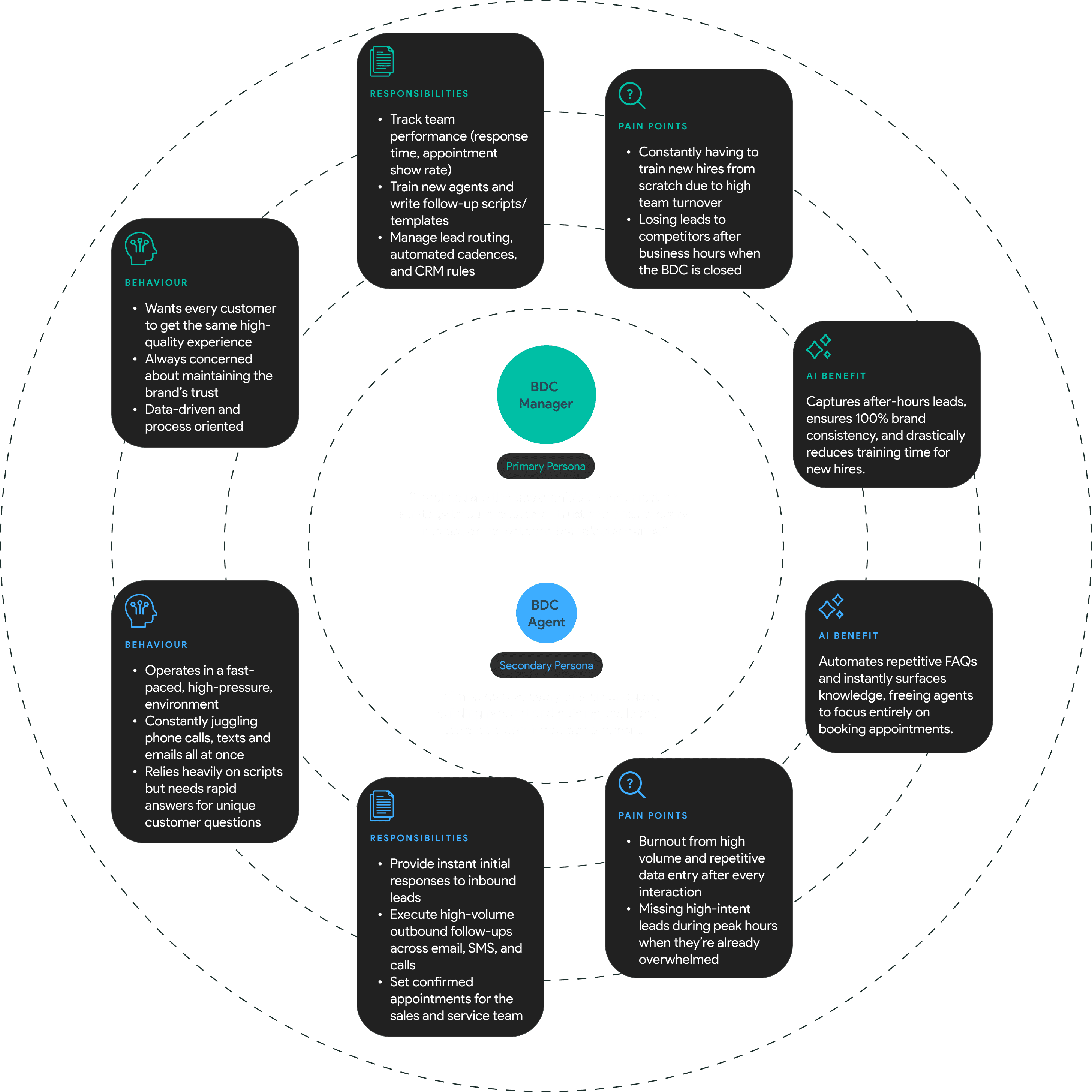
The initial requirement
The project kicked off with a seemingly simple task:
Design an intuitive Knowledge Base (KB) interface for a single BDC AI agent.
An AI agent isn't just a chatbot. It has three layers working simultaneously beneath every conversation the customer sees. The reasoning engine - the LLM, personality, fallback logic. The knowledge layer - what the agent knows and remembers. And the action layer - what it can actually do in your systems. The brief handed me one piece of this: the knowledge layer. Specifically, the interface for a BDC manager to populate it. That's what I had to build.
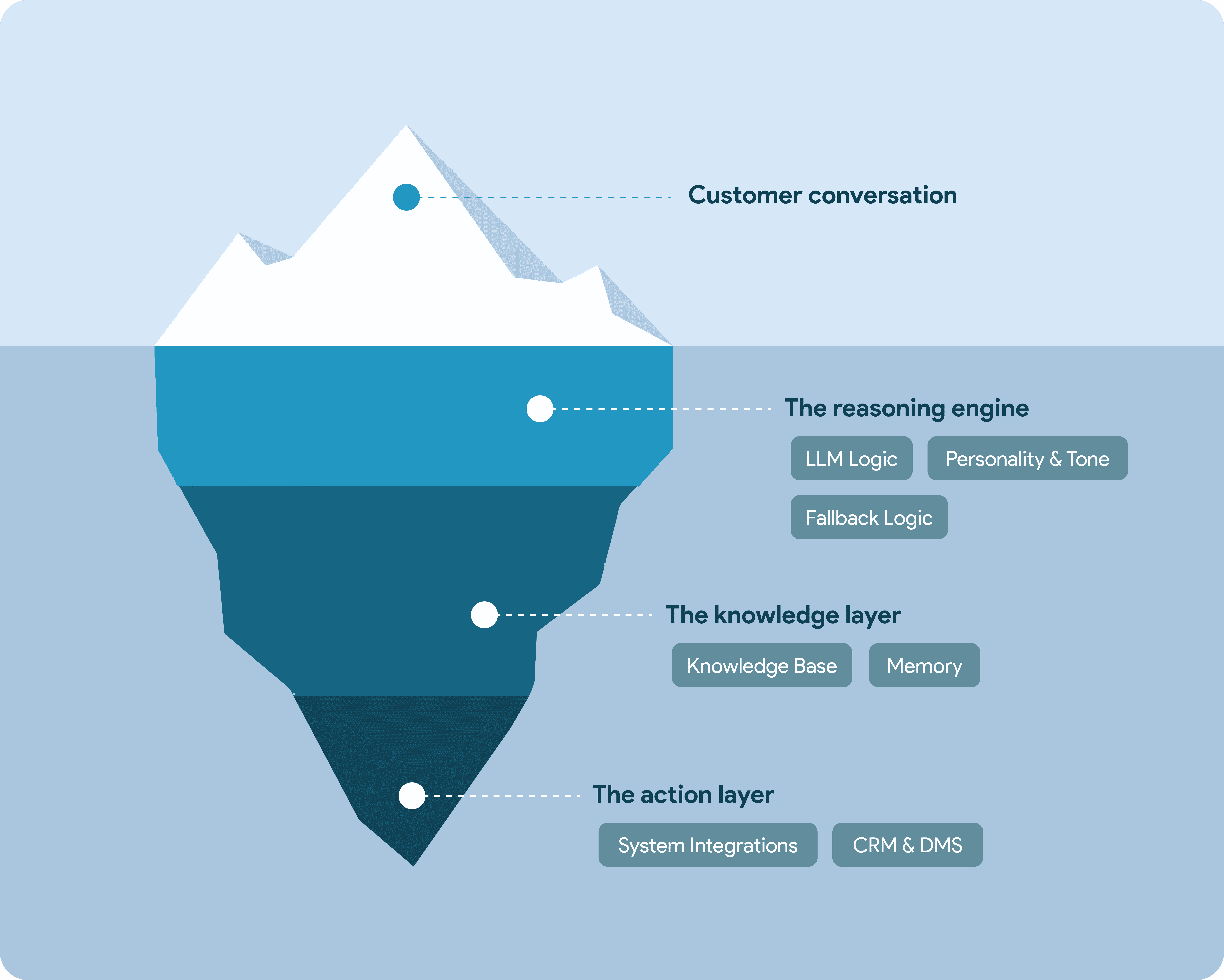
Anatomy of an AI Agent
The deep dive
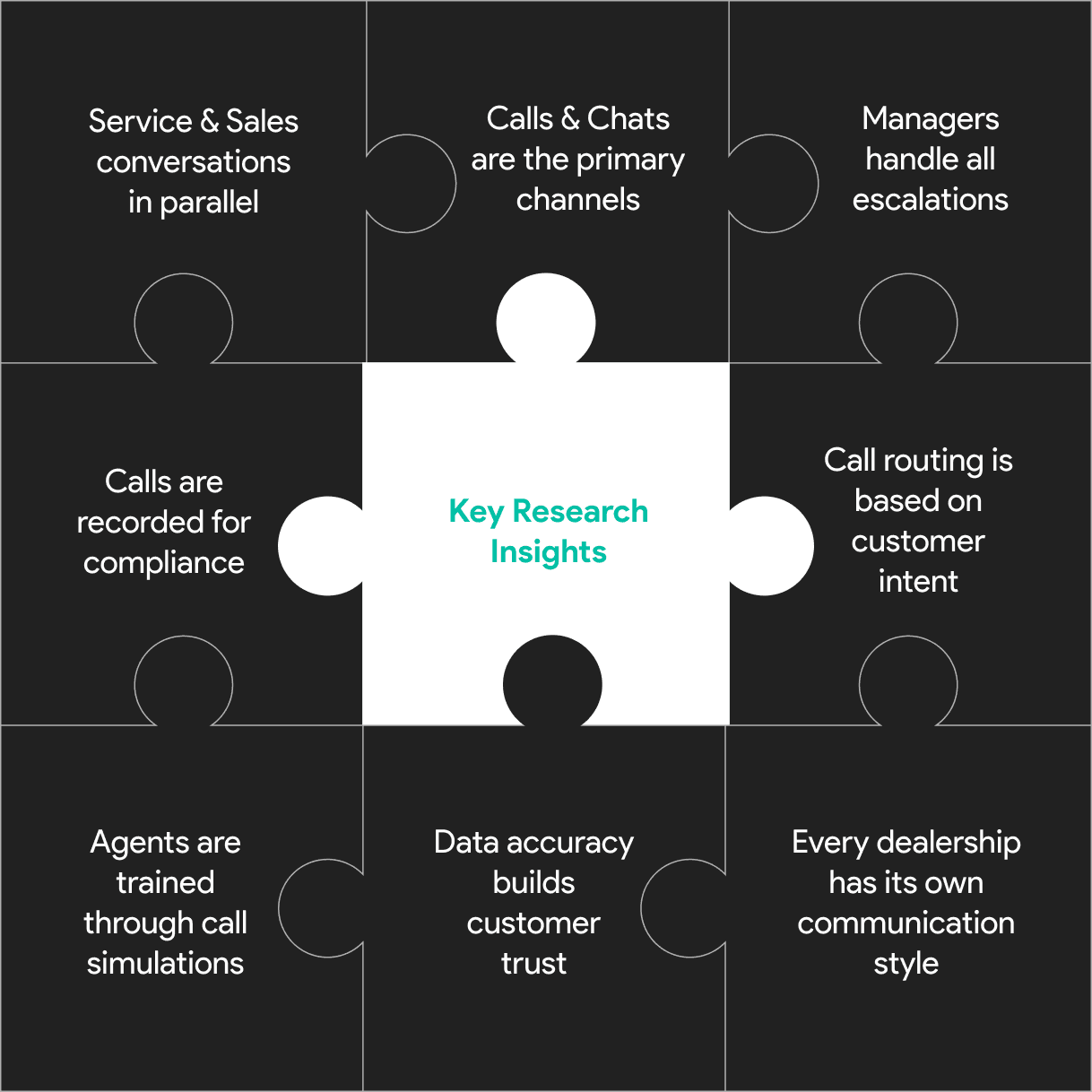
My discovery process involved conducting a deep-dive audit across PRDs, BRDs, and competitive landscapes, while synthesizing the stakeholder interviews and BDC call recordings to understand how BDC agents operate in a real world. A few critical insights emerged:
While my initial research defined the "how" of BDC work, a deeper audit led me to ask three fundamental questions that uncovered certain gaps in our KB strategy that would have prevented us from reaching the business's long-term vision:
Will each AI agent still have its own KB for general dealership questions?
(Redundancy problem)
How will the AI agent handle cross-department questions in one conversation without losing context?
(Context problem)
If separate KB for general questions is maintained, won't it create a debt as we scale to multiple agents?
(Scalability problem)
After synthesizing these questions, I couldn't shake one recurring observation.
Although we had defined the right ingredients - Personality, Tone, and Capabilities - we weren't building the robust 'brain' needed for a true BDC ecosystem. I recognized that the strategy needed to shift toward a scalable architecture for all future AI agents, aligned with the larger business vision.
How might we give BDC managers the confidence to set up and trust their AI agent - so customers always get timely, accurate responses across every touchpoint, while laying a foundation that scales as new AI agents are introduced?
Shift towards a modular knowledge framework
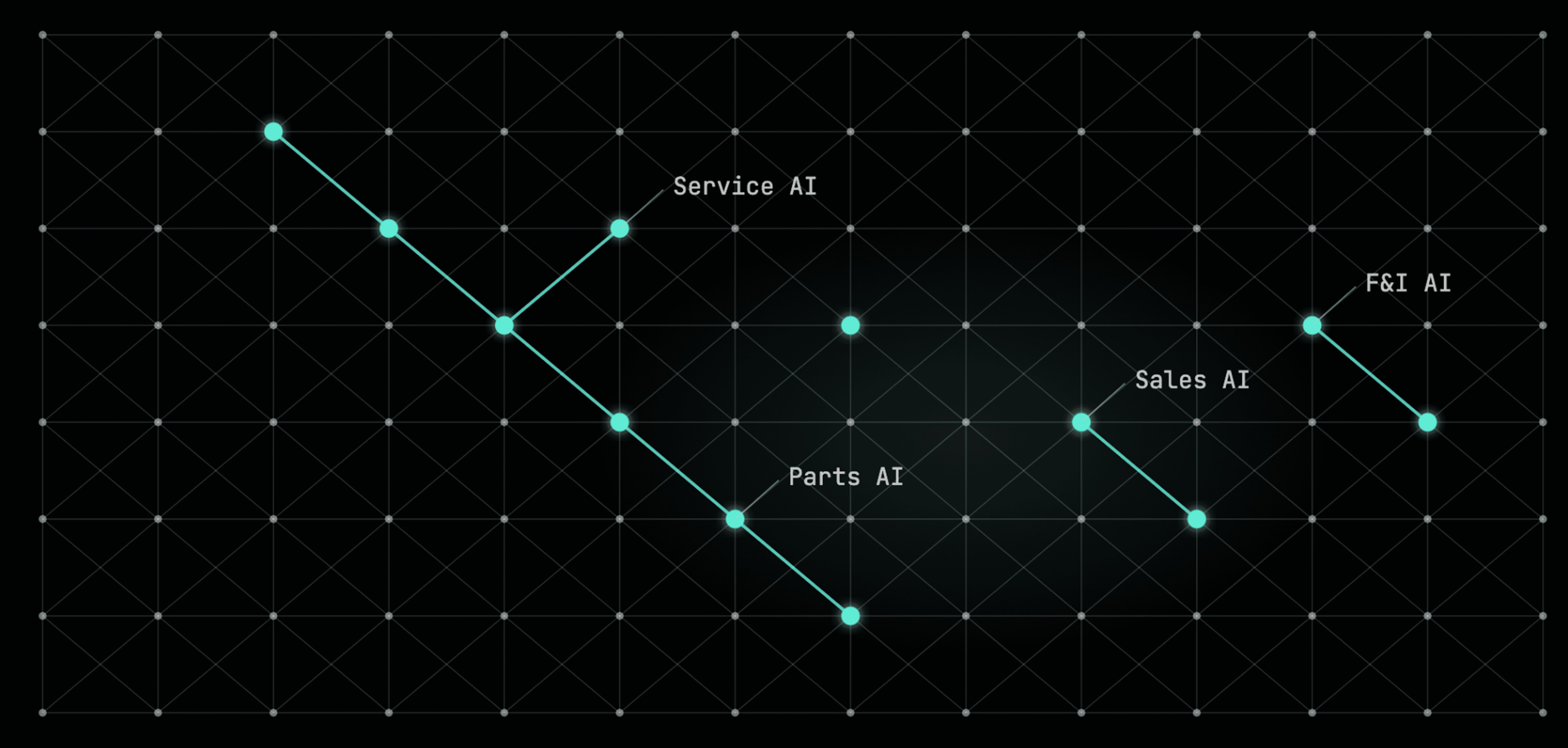
Through competitive analysis, I identified multi-agent architecture as an emerging industry pattern - seen in Salesforce Agentforce and Google's agent architecture - where specialised agents operate under an intent-based routing layer with access to a shared knowledge pool, fetching from relevant knowledge sources based on customer intent.
Recognising the complexity of the real BDC environment, I collaborated with the PM team to apply this pattern to our context - scoping a scalable framework that could handle the same edge cases, fallback scenarios, and compliance standards as the human agents it was designed to support.

This modular framework allowed us to treat dealership knowledge as a shared pool of interconnected components - where any agent can fetch from relevant knowledge sources based on customer intent, ensuring accuracy and consistency while keeping each departmental agent specialised and the overall system scalable as new agents are added.
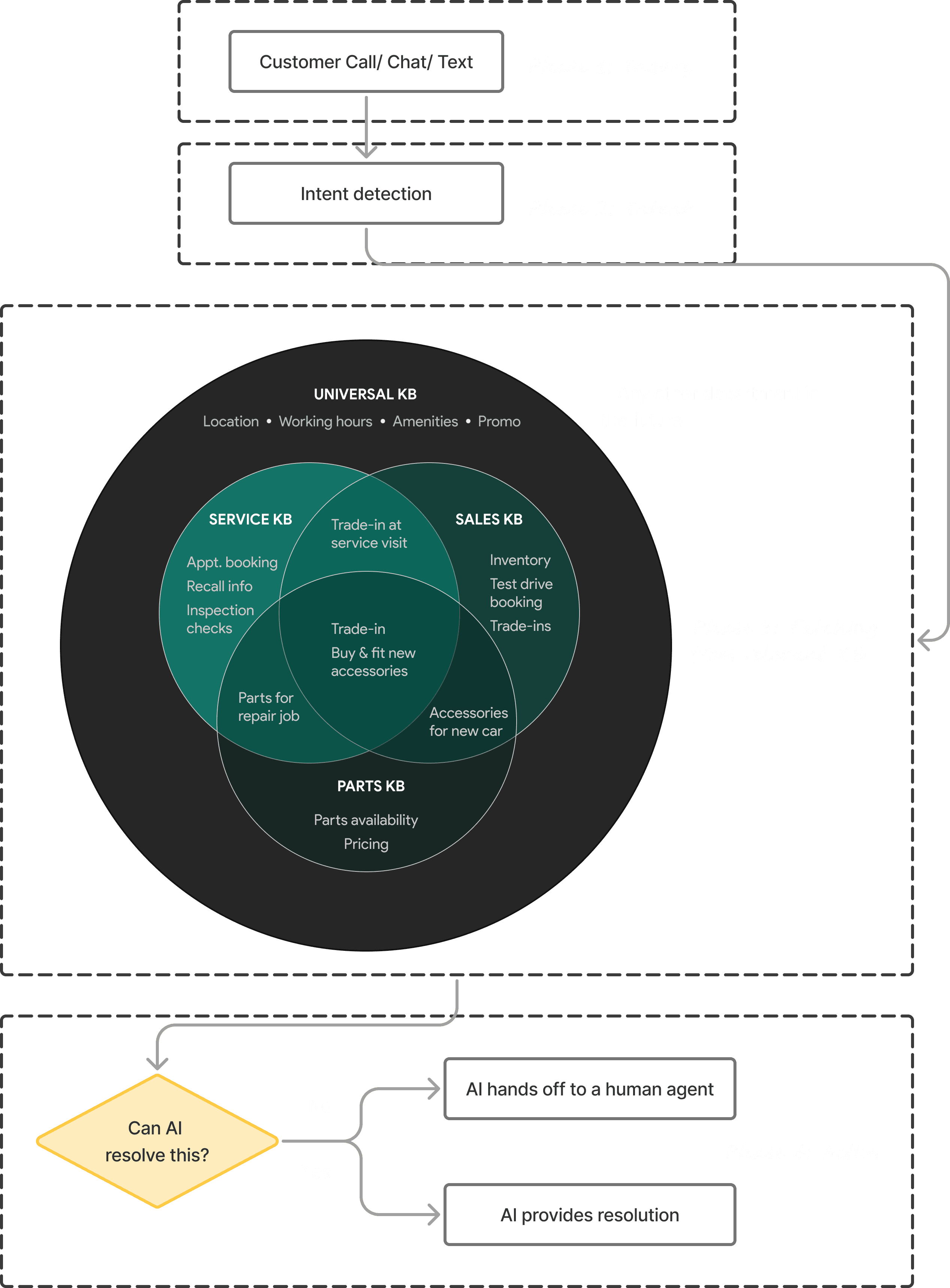
Let’s understand this with a real world scenario

The Inquiry: Mark calls reporting a shaking engine and inquires about service packages

Modular Routing: Ana (Service AI) checks the Service KB for the dealership's service packages, the DMS for live appointment availability

Cross-Department Action: Ana (AI) seamlessly routes to the Universal KB for shuttle policy and Sales KB to gather trade-in data (mileage, condition), alerting a Sales Specialist to prepare a valuation before Mark arrives
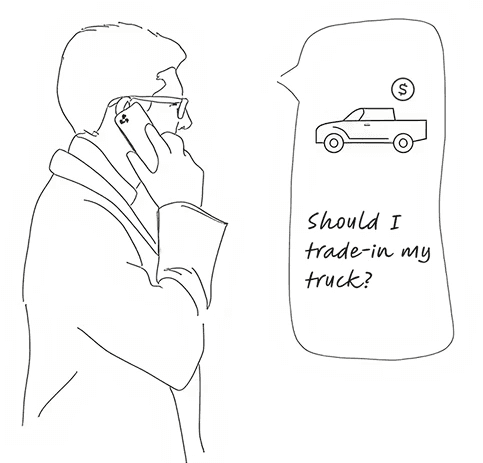
Intent Pivot: Mark accepts the service slot and ensures the shuttle policy but frustrated with the repairs, he also asks about his truck’s trade-in value
You can view explorations here
Defining the AI Fallback Logic
I mapped out fallback scenarios based on how real BDC conversations can break down — with the expectation that post-launch conversation data would help us refine and evolve these over time:
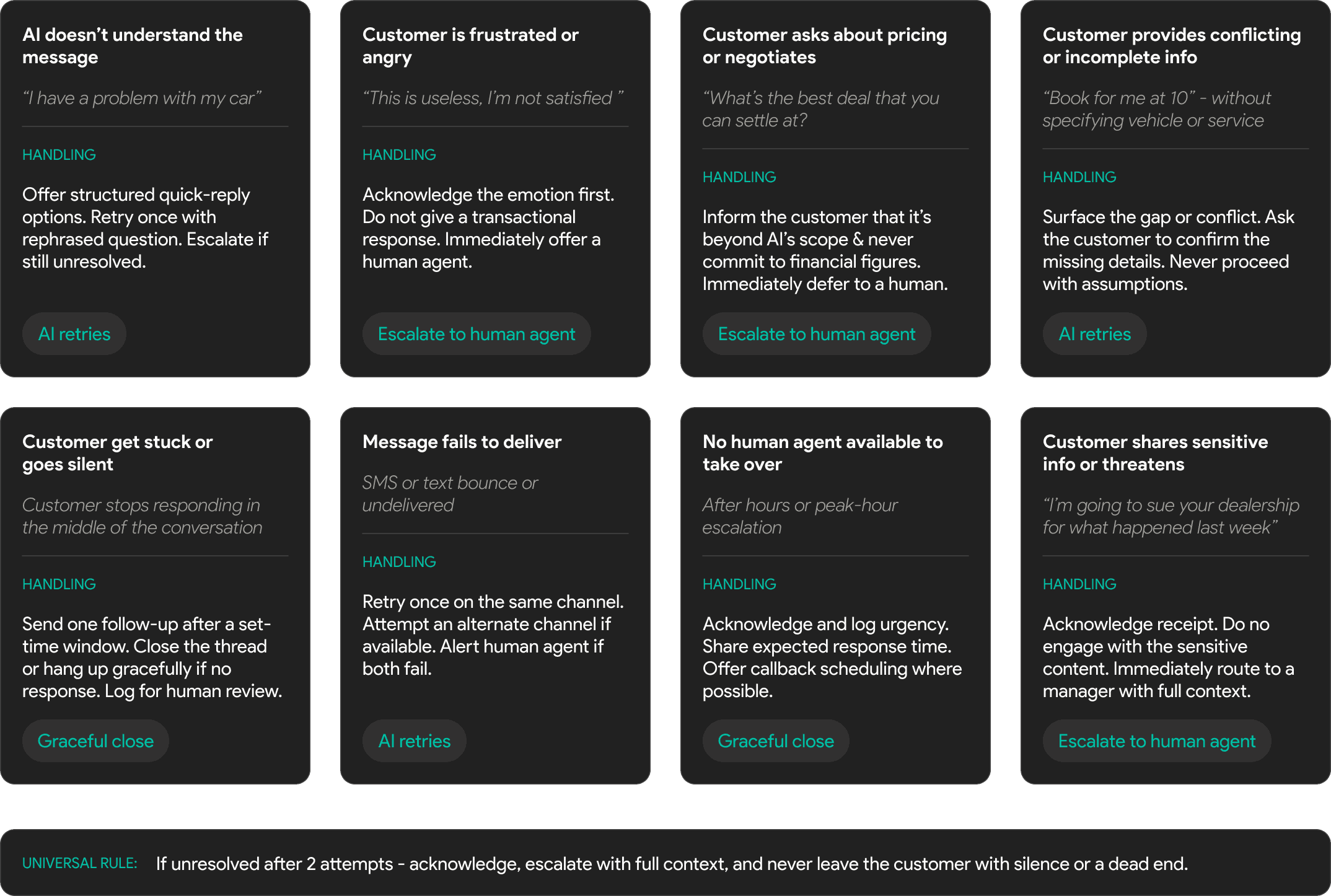
Testing AI before going live
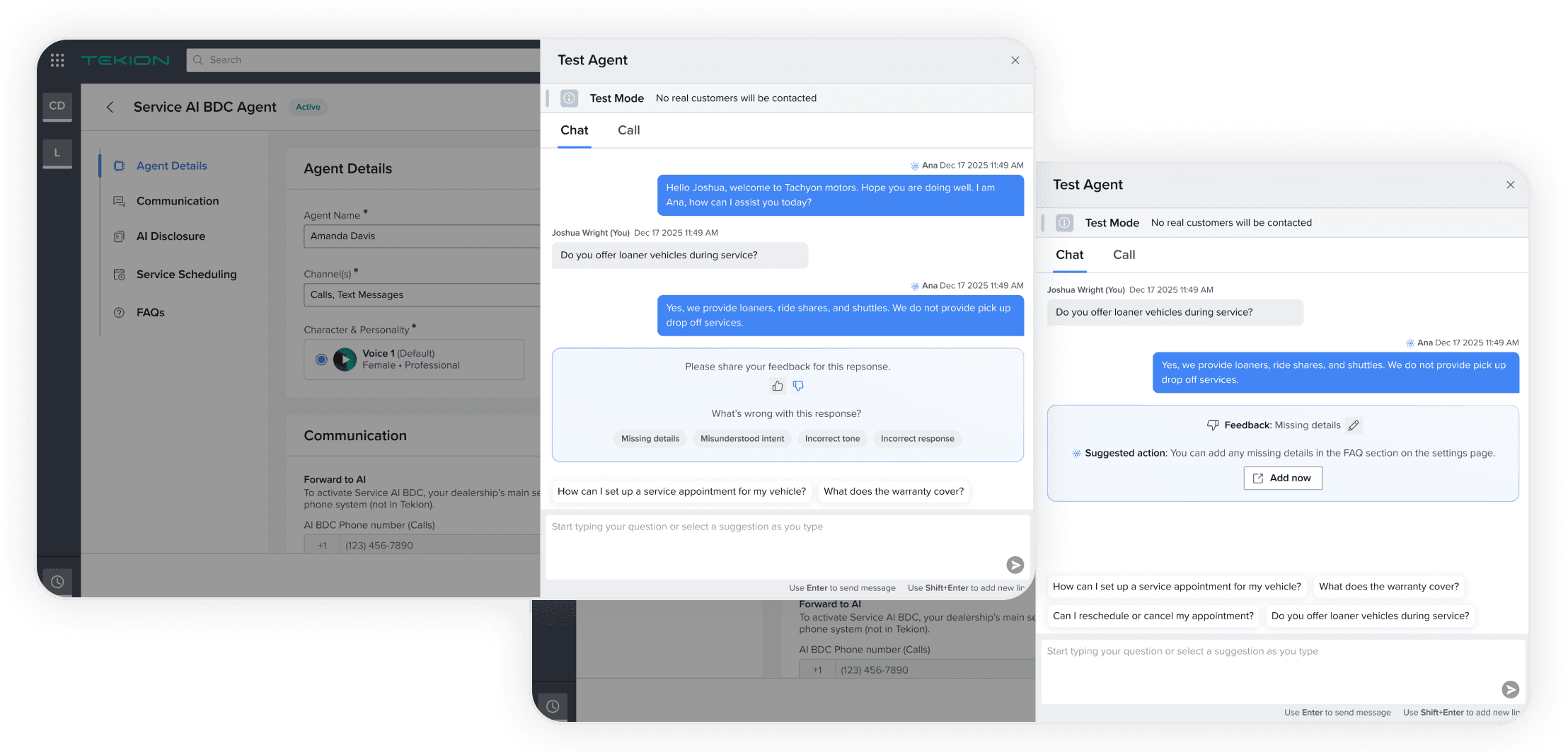
For the AI to operate confidently in a real dealership environment, BDC managers needed a way to test it like they would test a new agent - through structured simulations across the channels customers actually use. I designed an end-to-end test workflow within the platform that lets managers run, evaluate, and improve the AI before it ever speaks to a real customer:
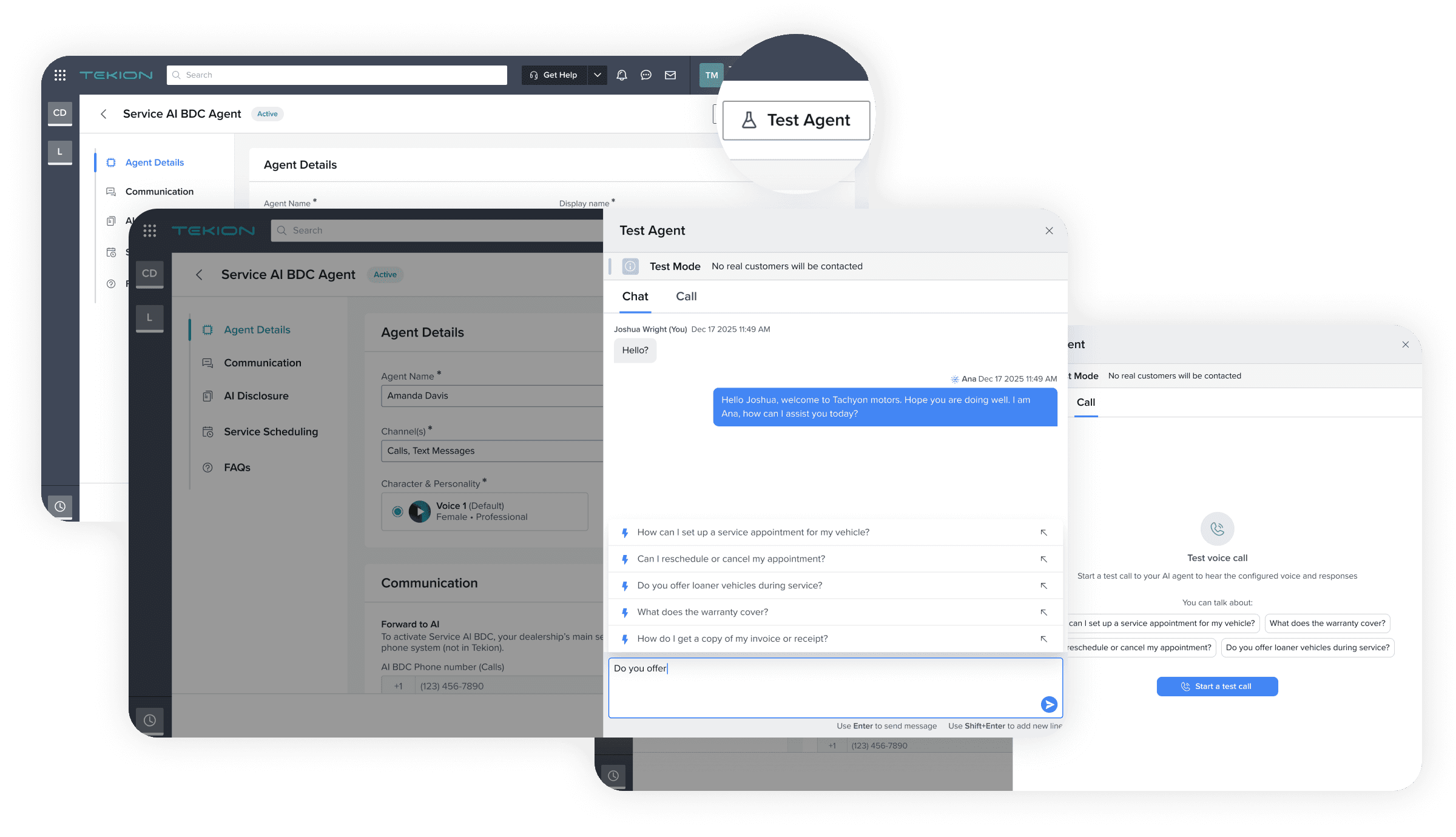
Running the Simulation
From any agent's configuration, managers can launch a test simulation in one click - across both channels customers actually use. Each test opens with the AI's real greeting and pre-defined dealership-specific prompts, so managers can quickly run scenarios without scripting from scratch.
Capturing feedback & Closing the Loop
Inline feedback is captured at every AI response - managers can rate accuracy, flag specific issues like missing details or incorrect tone, and instantly trigger updates to the knowledge base. Every flagged response loops back into the platform's configuration, turning each test into an opportunity to refine the AI.
You can view explorations here
The impact
We launched the Service AI Agent with a pilot cohort of 18 dealerships - with the Sales AI Agent already in the pipeline for the next 3 months, bringing the vision of a fully unified, multi-agent dealership platform one step closer.
79%
Dealerships self-activated
65%
Conversations resolved by AI
18
Rooftops live for pilot
Design bold.
Stay curious.
Don't be a stranger. Say hello!
arushi.aa13@gmail.com
Check out more About me
Copyright 2026 - Made with love by Arushi Arora |
You can also find me on